We would like to begin this section with a quote from two visitors who have perfectly captured what drives the museum in creating projects for and with the community:
The museum preserves the memory of the community and serves as an educational reference for younger generations, helping to develop historical awareness and a sense of cultural identity
Stefo&Vivi. Review by two visitors on TripAdvisor
Every museum, and especially a territorial museum like the one in Bracciano, belongs to its community. It only truly fulfills its purpose when the community recognizes it as its own. Naturally, the community should play an active role in shaping and implementing the museum’s activities, contributing to the mission of preserving the heritage it safeguards so that it may be shared and passed on to future generations.
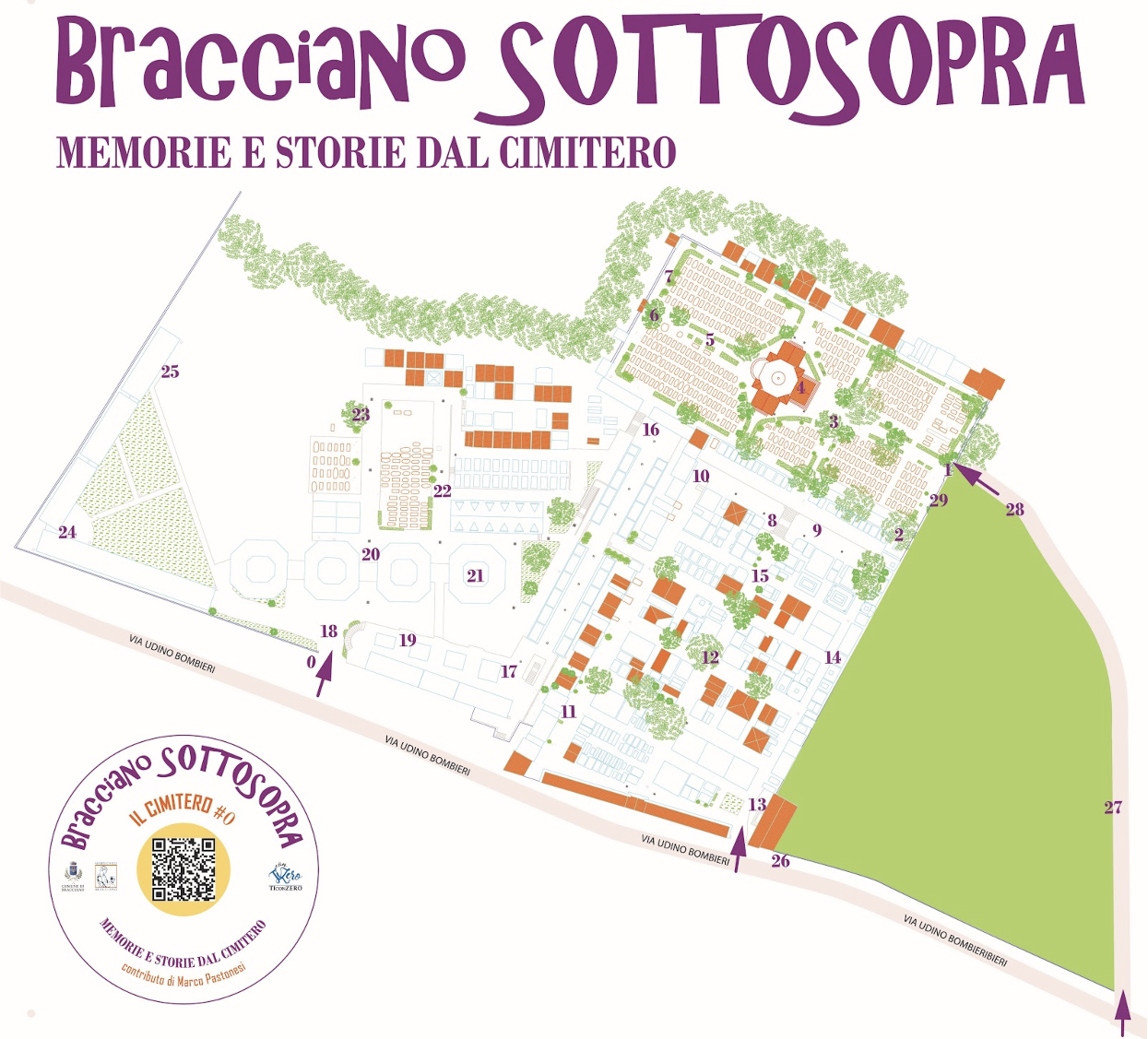
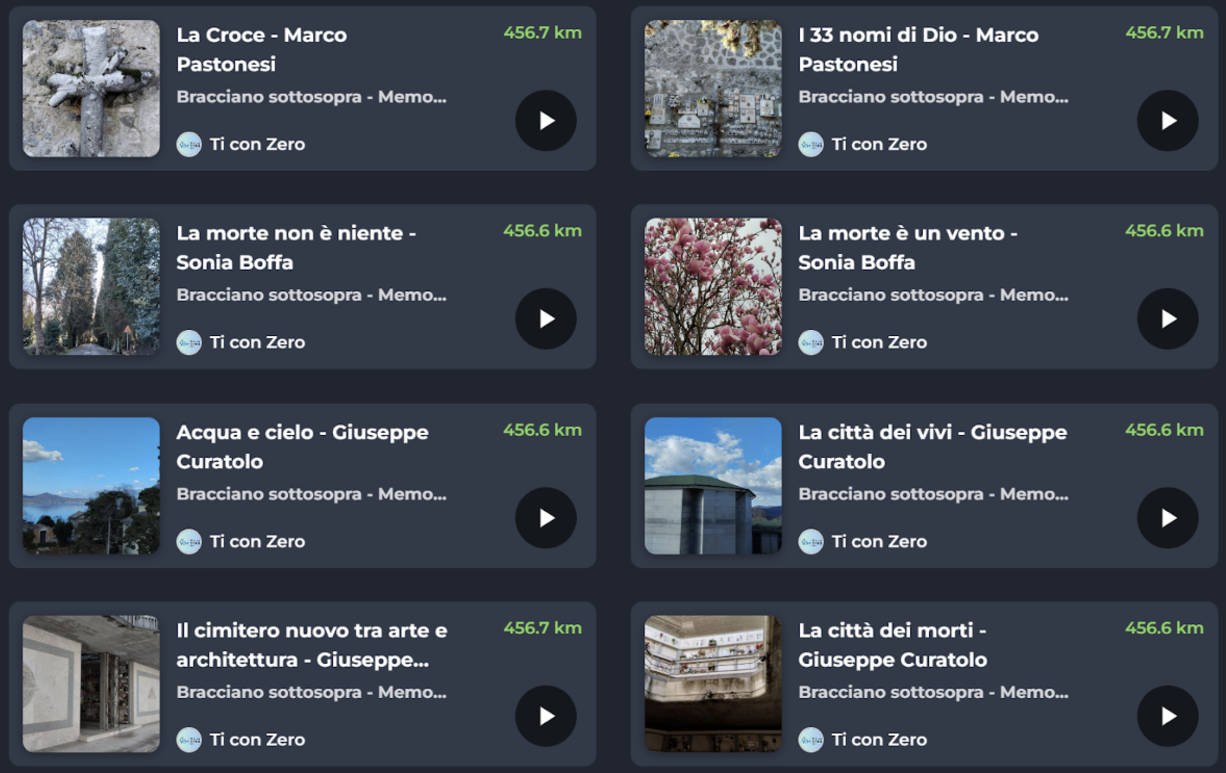
Every cemetery is a place that preserves the stories of cities. Bracciano Sottosopra: Memorie e Storie dal Cimitero (Bracciano Upside Down: Memories and Stories from the Cemetery) is a project that offers a sound itinerary within the cemetery. It collects personal narratives and reflections from citizens, making them accessible through audio recordings. The stories of Sonia Boffa, Giuseppe Curatolo, Massimo Giribono, Mario Gentilucci, Aldo Marziali, Massimo Mondini, Nerina Orsini, Marco Pastonesi, Cecilia Sodano, and Stefano Valente are featured on the Loquis audio platform, where they can be enjoyed by listeners. Bracciano sottosopra is the idea of Cecilia Sodano and was realised by Fernanda Pessolano of the Association TiconZero.
The project Preserving Memory involves the creation of an archive of testimonies through the collection of short videos in which the community tells the story of the town and of itself. Originally, these video interviews were meant to address specific themes identified by the museum, but during the course of the work, additional topics proposed by the citizens were also included.
2026. The project has been published, we have collected the testimonies of the citizens. Some of the people we interviewed include Salvatore Pierini, one of the key figures and organizers of the town’s festivals, particularly the feast of Santissimo Salvatore, and Clara Canini and Sisto Mercantini, who run a historic norcineria.


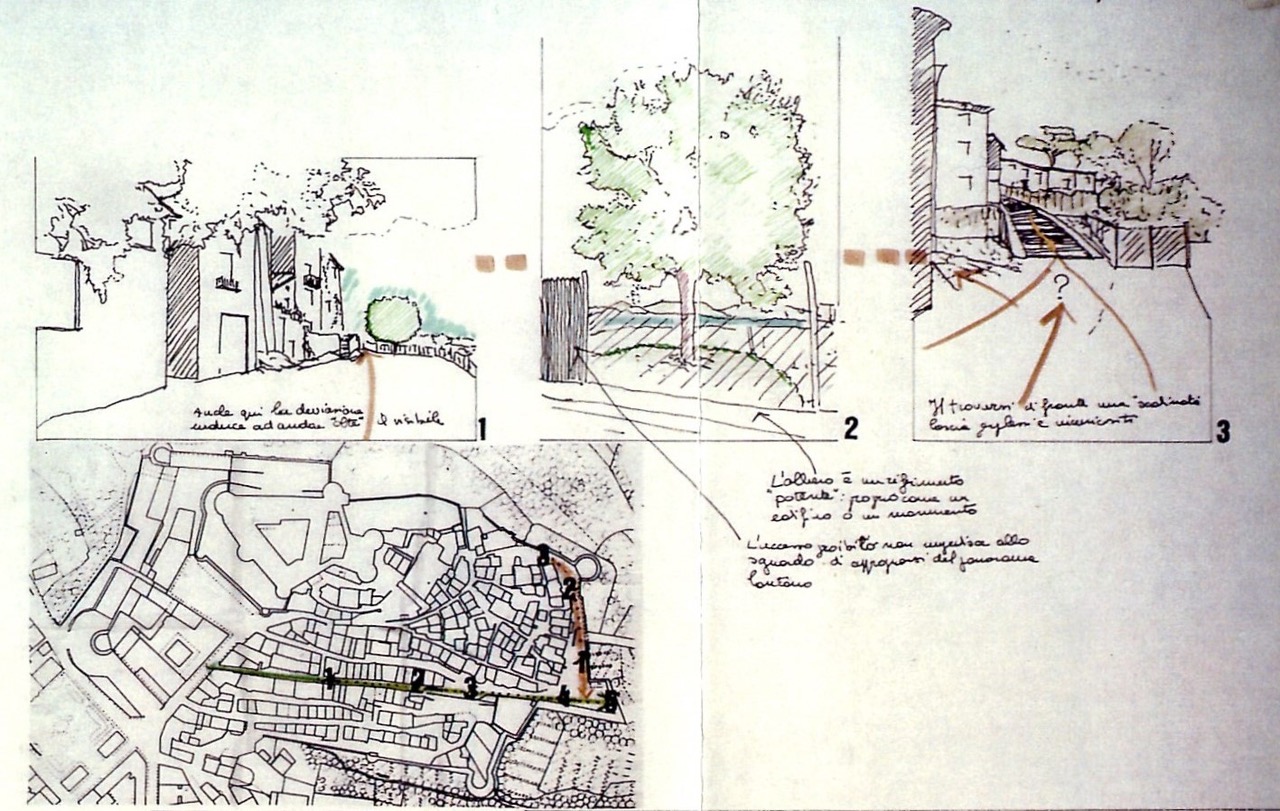
Community maps are geographical charts that creatively represent a portion of territory, highlighting both its physical elements (landscape, buildings, and environment) and intangible aspects (artisan knowledge, legends, historical events, sensations and emotions tied to places). The creation of a community map is a process of identity self-representation that reflects cultural heritage as it is experienced and perceived by the population involved. It is a collective narrative containing stories, accounts and experiences that connect past, present and future. The Civic Museum has decided to create a community map to represent what the local inhabitants recognize as their own cultural heritage.
2024. The project is ongoing. We are finalizing the program together with our expert, architect Irma Visalli, and seeking facilitators for the workshops in which we will meet with the population.
An event held in 2011 with the aim of promoting knowledge of Renaissance history in Bracciano. Over 15 days in December, lectures on history and art history, performances of Renaissance music and dance, and workshops on Renaissance cuisine were offered. The University of Tuscia, a partner in the event, organized the lectures; the local Slow Food association ran the workshops on Renaissance gastronomy; local restaurants and pastry shops in the historic town center offered their guests Renaissance menus based on recipes provided by the museum.
The centerpiece of the event was the theatrical performance “Io ti adoro bella,” produced by the museum, which tells the story of the Duke of Bracciano, Paolo Giordano Orsini, and his wife Isabella de’ Medici, who lived in the 16th century. The performance helped to spread the historical truth about the two figures. The City of Rome granted its patronage as the set design for the theatrical performance was based on documents from the Orsini archive, preserved at the Archivio Storico Capitolino.
The evolution of the concept of cultural heritage
By Director Cecilia Sodano.
Since the World Heritage Convention, international documents have seen the concept of natural heritage and then landscape placed alongside and subsequently overlapping with that of cultural heritage, which includes landscape as a bearer of particular values. While acknowledging that the debate on these themes is not the result of an organic evolution, it is nonetheless possible to outline a trend within which the idea of heritage has developed over time. Initially conceived as a set of material objects rigidly corresponding to the two categories of nature and culture, the concept of heritage has since expanded to an interdisciplinary vision that encompasses not only material and immaterial elements, but also ideas and values.
Reflection on landscape and cultural landscape has been a key turning point in this journey, inextricably linking nature and culture, people and places, tangible and intangible elements. The conception of heritage has further expanded with the European Landscape Convention (2000) and with the Faro Convention (2005), which consider landscape and heritage as fundamental resources for human well-being and sustainable development. Both European documents have shifted attention from the landscape/heritage object to the people called upon to perceive/recognize it. This has opened new perspectives for public participation in an approach that shifts from object to action, from product to process.
The involvement of communities in the process of recognizing the value of landscape/heritage implies shared responsibility for protection, conservation and, in the case of landscapes, management and planning. This responsibility significantly involves museums, which are entrusted with the important role indicated by the Recommendation resulting from ICOM’s 24th General Conference, which constitutes a major challenge for the years to come: on the one hand, the management and maintenance of heritage with a view to sustainable development for the territory; on the other, attention to the images and representations that identify and characterize the landscape itself.
Text extracted from the article: C. Sodano, Cultural Landscapes in International Charters, Museum International, 69 (1–2), pp. 82–85, 2017. doi: 10.1111/muse.12152
Matteo Minissi, son of the great architect Franco, welcomes us into his family home, where they lived for many years in Bracciano, and tells us about his father. Casa Minissi is a construction of great architectural quality, very distinctive, a sort of ‘glass box’ that intimately dialogues with the surrounding landscape, whose interiors catapult the observer directly into the 1970s.
This special construction, its garden, and the sculptures express beauty in a domestic and private dimension and tell us much about the creativity and genius of the architect Minissi, who was its designer and creator. The house represented for Minissi a place of experimentation: we find here represented, albeit on a small scale, some ideas later used for his most important projects.
Franco Minissi, born in 1919, worked in restoration and museography, subjects in which he was a university professor in Florence and Rome. He interpreted the museum as an instrument of critical reading, close to the theories of Cesare Brandi, always privileging an approach respectful of the monument and the document.
Minissi curated numerous museographic installations and musealization of archaeological sites. Among his most renowned projects are, as mentioned in the video, the renewal of the installations of the National Archaeological Museum of Villa Giulia (1953-1960) and the project for the protection and musealization of the mosaic pavements of the Roman villa del Casale in Piazza Armerina, in collaboration with Cesare Brandi (1957-1963). In the account of his son Matteo, the memory of the great architect blends with the memories of Matteo as a child, giving us a pleasant family portrait of the master, little known and therefore all the more precious.
Amleto Flamini recounts the adventurous story of his father Salvatore, a Bracciano native born at the beginning of the twentieth century who worked as an engine mechanic at the Vigna di Valle Air Force base from 1929 until his retirement, collaborating on several important innovative projects developed at the aeronautical base.
Among these was the F.F.F. motobomba, named after the initials of its designers: Lieutenant Colonel Prospero Freri, Colonel Amedeo Fiore, and chief draftsman Carlo Filpa. It was a self-propelled device, revolutionary for its time, comparable to a torpedo with a spiral trajectory, to be used primarily against vessels in port and at anchor; an example is preserved in the MUSAM Historical Museum of Vigna di Valle.
Mr. Amleto also recounts the epic feats of the T-108 hydroplane, designed by Prospero Freri and his collaborator Giuseppe Funmanick. Freri participated in the 1938 Pavia-Venice Raid, a historic motorboat competition, finishing in second place; Salvatore Flamini was with him. Salvatore’s story reminds us how, with tenacity and will, one can overcome the difficulties that life presents while fulfilling one’s vocation.
Marco Marini shares with the Civic Museum the video interview he and his brother Alessandro conducted in 2017 with their mother Mirella Ferranti, who was the heart and soul of the historic Bar Sabazio from the 1960s onward.
Bar Sabazio, which is still located on Via XX Settembre in Bracciano today, was moved there in the 1960s and became one of the town’s gathering places, but the establishment where the Ferranti family began their business was the Albergo Ristorante Sabazio, which was located on Via Principe di Napoli at the corner with Via Paolo Traversini.
Mrs. Mirella’s memories begin in the 1940s, when she was a child and her family managed the hotel restaurant. Sad memories alternate in her account with amusing anecdotes, always recounted with a smile: the Germans who requisitioned the hotel and took everything away at the end of the war, the dance parties and New Year’s Eve balls of the 1950s, and then the memories connected to the new bar on Via XX Settembre, which was very popular and appreciated for its specialties even by the artists who frequented the town.
Mrs. Iole recalls the period of the Second World War as seen through her eyes as a child. Her parents, farmers, worked on the tenant farms of Prince Odescalchi and lived in a farmhouse in the upper area of Bracciano, at the top of Via Carlo Marchi, which was then open countryside.
In Iole’s memory, the war was felt in Bracciano especially in the period after September 8, 1943, the date of the armistice between Italy and the Allies. For the children, as she was then, the war was experienced with some fear but without great suffering. Bracciano was then a rural town and it was easier to have food compared to the cities.
Iole’s account takes us back to the simple life without means that was lived in those years. The German soldiers are described in their humanity as young men, fed by her mother with homemade bread. Among her memories is also the sacrifice of Sergeant Major Udino Bombieri, partisan, Gold Medal for Military Valor awarded posthumously, and the bombing of Bracciano on June 1, 1944 by the Allies, who while attempting to strike the railway and military installations also hit the cemetery and the building located at number 76 Via Principe di Napoli, where numerous tenants lost their lives.
Clara and Sisto were the owners and managers of the historic norcineria ‘La Moretta’, opened by Clara’s parents Antonio Canini and Vincenza Rugari and active in Bracciano for over sixty years, until 2026. Throughout the period of activity, the norcineria, which takes its name from the nickname given to Vincenza in the town, produced porchetta cooked over wood in the family oven.
Sisto and Clara take turns recounting the family business, starting from when Clara’s father decided to dedicate himself to porchetta production and describing the Bracciano tradition of this beloved food, once produced by multiple vendors with multiple sales stands. Clara becomes emotional recounting the love and pride for her parents’ work.
The tradition of Bracciano porchetta continues today with the business of Clara and Sisto’s son, who runs a fraschetta and continues to produce porchetta for his establishment according to tradition, in the family wood-fired oven.
Mrs. Maria Teresa recounts her youthful experience in the women’s needlework workshop, where she learned her trade, of which she retains a very pleasant memory. The workshop was established, perhaps in 1857, by the will of Princess Sofia Branicka Odescalchi, who entrusted its management to the Sisters of Charity of Saint Vincent de Paul with the aim of training the local young women.
Girls who could afford to continue their education after completing elementary school were admitted, because they had families that could do without their labor contribution, and they remained there until they found work or married. The sisters taught them embroidery; a small section was dedicated to knitting. Time was marked by prayer and song; work was made light by the girls’ laughter.
It is not known where the workshop was originally located; from 1876 it was housed in the Augustinian Convent with access from Piazza del Forno, now Piazza Mazzini, which became municipal property in 1873.
After activities were suspended due to the war, the workshop was reopened in 1947 at the premises on Via Agostino Fausti 2, owned by Prince Odescalchi, under the guidance of Sister Giuseppina Petrucci. A large hall on the second floor accommodated approximately 70 students divided into three age groups, from 12 to 20 years and older, which Maria Teresa remembers well.
In 1953 the management by the Sisters of Charity ended, and in 1954 the workshop was reopened by the Sisters of Divine Love in their convent, where the activity continued until 1968 under the guidance of Mother Elvira and then Mother Palmira. By giving them the opportunity to learn a trade, the women’s needlework workshop constituted for many young women of Bracciano an instrument of emancipation in times when women’s emancipation was taking its first steps in Italy. The legacy of the workshop is still alive in the town through the memories of many of the students and through the presence of the works produced, some of very high quality.
Salvatore Pierini recounts the feast of the Most Holy Savior, one of the oldest and most important celebrations in the town. Since time immemorial, the people of Bracciano have venerated and carried in procession the wooden triptych created in 1315 by Gregorio and Donato d’Arezzo, which depicts the Savior, the Madonna of the Girdle, and several saints including Saint Stephen, patron since 1427 of the town’s oldest parish. The panels, whose copies are still carried in procession today in a seventeenth-century wooden processional structure, bear the coat of arms of the Prefects of Vico, ancient lords of Bracciano and probable patrons.
Originally the feast was held on August 15; since 1718 it has been celebrated on the first Sunday thereafter due to an agreement between the Augustinian friars of Santa Maria Novella and the secular priests of the Chapter of Santo Stefano, which stipulated that on the 15th the friars would hold their own procession dedicated to the Assumption of Mary.
The agreement arose from a dispute between the two religious institutions, which never got along, concerning the Savior triptych itself, kept in Santo Stefano but traditionally carried in procession to the Augustinian church on the evening of August 14 and kept there until the evening of the 15th. The dispute lasted over one hundred and fifty years, until 1797, with dramatic turns, lawyers, lawsuits, and the involvement of bishops and Vatican hierarchies. Although the Augustinians left Bracciano decades ago, the feast continues to be traditionally celebrated on the first Sunday after August 15.
Salvatore recounts the legend of the discovery of the panels of the Most Holy in the sixteenth century by a farmer who was plowing. The same legend associated with the Savior is found in other places, for example in Viterbo, and may perhaps be traced to the importance that confraternities of herdsmen and farmers once held in an essentially rural world.
Salvatore was for years one of the porters who carry the triptych in procession, and with his experience he now plays an important role: he is the one who guides the porters in the delicate and complex operations necessary to bring the large processional structure out of and then back into the church of Santo Stefano, and who directs them during the procession.
Mr. Salvatore recalls his childhood games in the early 1950s: playing ball in Piazza Mazzini, ‘nizza,’ and others. The perspective is, naturally, masculine, with games that favor manual skill and competitiveness.
Salvatore’s memories reveal the inexhaustible capacity of children of that time to invent games with simple and recycled objects and their ability to form groups in the places of the town’s historic center that represented their social spaces. The account also reflects some old trades, some of which have now disappeared, such as the ‘facocchio.’
Mrs. Laura tells us about the Feast of San Liberato, one of the most beloved by the community, which took place on the San Liberato estate, owned by the Sanminiatelli counts. The location is at kilometer 20 of Via Settevene Palo, First Section. Within the estate were originally the small ninth-century church and a large meadow overlooking the lake; several paths led there from nearby places.
The splendid current garden, designed by the great English landscape architect Russel Page, was commissioned in the 1960s by Count Sanminiatelli and his wife, Princess Maria Odescalchi.
On the first Thursday of March, the noble family made the location available for the enjoyment of the population. People arrived at San Liberato from Bracciano and neighboring towns along the paths that converged on the estate with whatever means were available to them, but especially on foot, singing and carrying baskets and bundles full of food. Laura Polidori recounts that after greeting the Saint, people would gather in groups on the large meadow and engage in merry revelry until evening. The celebration was enlivened by the Bracciano Mandolin Orchestra ‘La Primavera,’ founded in 1920 and still active today. Until the early decades of the twentieth century, Bracciano was a rural town, and communal festivities were the only occasions for rest, entertainment, and socializing during which, with the strict family control relaxed, first romances could blossom.
The account reveals the cheerful atmosphere of the feast, delighted by food and good wine, of which Laura still preserves a pleasant memory of her youth, and how it was once possible to enjoy oneself in simpler ways than today.
Mr. Mario, like Mrs. Iole Magliani, speaks to us about the period of the Second World War, when he was just a few years old. His memories provide an image of daily life in Bracciano seen through the eyes of a child, yet one in which the full complexity of life in wartime and its horrors can be re-read, such as the difficulty of traveling after September 8, 1943, and the bombing of Bracciano in 1944.
The anecdotes reveal the responsibility entrusted to children in those years; even very young children were often left alone or in the care of older siblings due to their parents’ work needs and were asked to contribute to the management of the household. However, the war also left Mr. Mario with pleasant memories, such as the first candies and chocolates received upon meeting the Allied army.
The Director of the Bracciano Civic Museum, Cecilia Sodano, introduces the project, explaining that it is inspired by the Faro Convention, an important Council of Europe document that reaffirms the right of everyone to participate in cultural life.
The Director notes that the interviewees’ accounts do not always claim historical truth because memory, unlike history, has a direct relationship with the past and is therefore selective and subjective.
The project is a way to preserve fragments of Bracciano’s past that represent part of its collective identity, to be passed on to anyone who wishes to know them, especially the younger generations.
Giuseppe Curatolo takes us to Bracciano in the late 1960s as seen through the eyes of a ‘pimply teenager’. The architect imagines a typical day spent in 1968 on Viale Odescalchi, the street connecting the train station with Via Principe di Napoli, which in those years was the center of social life for the town’s youth.
Giuseppe recalls the places, people, and certain particular events of his adolescence, offering us a snapshot of everyday life, the aspirations, and the attitudes of Bracciano’s youth in the years when the world was going up in flames.
Among the memories is also the making of the film “Simenon,” a crime story shot between Viale Odescalchi and other locations in the town, featuring a murder and American-style car chases, conceived and directed by Socrate Pontanari. The lead actors were the young people who gathered around the bar La Fiorita on Viale Odescalchi, owned by Socrate, which was their meeting place.